
How to Brew High-Alcohol Hard Kombucha at Home: Step-by-Step Fermentation Process
✨ This article was AI edited. Editorial responsibility: OriginalEating.com.
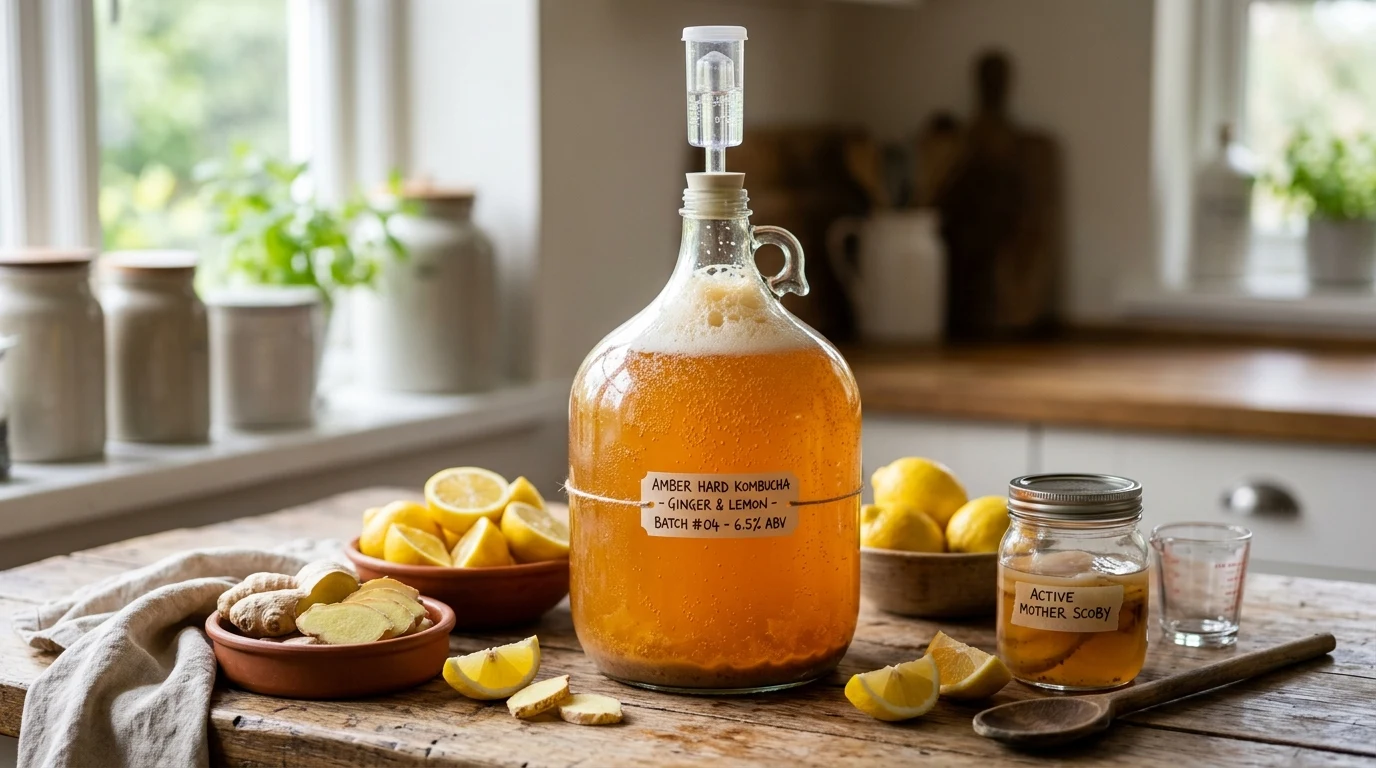
Kombucha brewing with alcohol (commonly called hard kombucha) is a dual-stage fermentation process where traditional symbiotic culture of bacteria and yeast (SCOBY) fermentation is followed by a secondary anaerobic fermentation utilizing dedicated brewer’s or champagne yeast and supplemental fermentable sugars to elevate alcohol by volume (ABV) from trace levels (<0.5%) up to 4.5%–8.5%.
While standard homemade kombucha naturally contains minuscule traces of ethanol as a byproduct of yeast metabolizing sucrose, crafting authentic hard kombucha requires deliberate intervention. Left unchecked in an aerobic vessel, acetic acid bacteria (AAB) quickly oxidize ethanol into acetic acid, creating that signature tangy vinegar bite. To elevate alcohol content while preserving probiotic complexity and effervescence, home brewers must transition the liquid into an anaerobic, airlocked environment with specialized yeast strains capable of higher alcohol tolerance.
Contents
- Understanding the Biochemical Fermentation Spectrum: Standard vs. Hard Kombucha
- Essential Equipment and Sanitization Protocol
- Yeast Selection: Choosing the Engine of Alcohol Production
- Step-by-Step Methodology: Brewing Hard Kombucha at Home
- Troubleshooting Common Hard Kombucha Brewing Pitfalls
- Frequently Asked Questions About Hard Kombucha Brewing
Understanding the Biochemical Fermentation Spectrum: Standard vs. Hard Kombucha
To successfully master brewing kombucha with noticeable alcohol content, one must grasp the delicate metabolic equilibrium inside the fermentation vessel. A standard SCOBY is an intricate consortium consisting predominantly of Komagataeibacter xylinus, Gluconacetobacter, and wild yeasts such as Zygosaccharomyces and Brettanomyces.
| Metric / Parameter | Standard Kombucha (Primary) | Hard Kombucha (Secondary) |
|---|---|---|
| Target ABV Range | 0.2% – 0.5% (Non-alcoholic) | 4.5% – 8.5% ABV |
| Oxygen Exposure | Aerobic (Cloth cover / breathability) | Strictly Anaerobic (Airlocked carboy) |
| Primary Microorganisms | SCOBY wild yeast + Acetic acid bacteria | Cultured Brewer’s/Champagne Yeast (EC-1118, US-05) |
| Fermentation Duration | 7 – 14 Days | 10 – 21 Days |
| Acidity (pH Level) | 2.5 – 3.2 pH | 3.2 – 3.8 pH (Hydrated prior to pitch) |
Essential Equipment and Sanitization Protocol
Cross-contamination and wild bacterial infections represent the highest risk factor when attempting secondary high-gravity fermentation. Because standard brewing equipment houses aggressive acetic acid bacteria, isolating your alcoholic carboy is imperative.
- Food-Grade Glass Demijohn or Carboy (1 to 5 Gallon): Narrow-neck glass fermenters minimize headspace and surface air contact.
- Twin-Bubble or Three-Piece Airlock with Rubber Bung: Filled with sanitizer solution or high-proof neutral spirit to release fermentation CO2 while blocking ambient oxygen and acetobacter.
- Hydrometer & Test Jar: Essential for taking Original Gravity (OG) and Final Gravity (FG) readings to mathematically verify alcohol percentage.
- Auto-Siphon and Food-Grade Silicone Tubing: Minimizes liquid agitation and oxygen dissolution during transfer between vessels.
- No-Rinse Sanitizer (Star San or IO-Star): Every surface touching the brew after the primary stage must be fully sanitized.
Yeast Selection: Choosing the Engine of Alcohol Production
Wild SCOBY yeasts rarely tolerate ethanol levels above 2% ABV and lack the vigor required to attenuate dense sugar syrups under high-acidity conditions. Selecting an isolated commercial yeast strain is vital:
- Lalvin EC-1118 (Champagne Yeast): The industry workhorse. Highly competitive, tolerates alcohol up to 18% ABV, ferments rapidly across wide temperature spectrums (50°F–86°F), and produces an ultra-clean, dry sensory profile that allows fruit adjuncts to shine.
- SafAle US-05 (American Ale Yeast): Preserves subtle malt and tea ester complexities. Tolerates alcohol up to 9%–11% ABV and finishes slightly sweeter, balancing natural kombucha tartness.
- Lalvin 71B (Wine Yeast): Capable of metabolizing up to 20%–40% of malic acid into lactic acid, yielding a smoother, less sharp mouthfeel in fruit-forward hard kombuchas.
Step-by-Step Methodology: Brewing Hard Kombucha at Home
Phase 1: High-Base Primary Fermentation (Days 1–8)
Commence with a robust sweet tea foundation using organic black and green tea leaves. For a 1-gallon batch, steep 15 grams of whole-leaf camellia sinensis in 14 cups of filtered water with 1 cup of organic cane sugar. Once cooled below 78°F (26°C), add your active SCOBY pellicle and 2 cups of mature starter tea. Ferment under breathable cotton for 7 to 8 days until the brew reaches a lightly sweet-tart profile (pH approximately 3.4–3.6). Do not allow it to become bone-dry vinegar.
Phase 2: Hydrometer Calibration and Sugar Feed Preparation
Remove the SCOBY and retain reserve starter tea for subsequent non-alcoholic batches. In a separate sanitized saucepan, create your secondary fermentable wash. Dissolve 1 to 1.5 cups of organic dextrose, honey, or raw cane sugar into 2 cups of boiling filtered water. Allow this concentrated simple syrup to cool completely to room temperature (70°F–75°F). Pour the syrup into your sanitized secondary carboy, siphon in your primary kombucha, and stir gently with a sanitized wand. Draw a sample to record your starting specific gravity (typically 1.040 to 1.060 for 5%–7% target ABV).
Phase 3: Yeast Rehydration and Pitching
Acidity in kombucha can shock dehydrated yeast cells. Rehydrate half a packet (2.5 grams) of your chosen yeast strain in 50ml of lukewarm sterile water (95°F–100°F) for 15 minutes with a pinch of yeast nutrient (diammonium phosphate). Slowly temper the yeast slurry by adding tablespoons of your sweetened kombucha over 10 minutes to acclimatize the culture to the lower pH. Pitch directly into the carboy, attach the bung and airlock, and position in a dark closet maintained between 68°F and 74°F.
Phase 4: Anaerobic Secondary Fermentation (Days 9–21)
Within 24 to 48 hours, active bubbling will commence in the airlock. Vigorous CO2 generation creates a protective gas blanket over the brew, forcing lingering acetic acid bacteria into dormancy. Allow fermentation to continue undisturbed for 10 to 14 days until airlock activity decelerates to fewer than one bubble every 60 seconds. Test specific gravity; when gravity remains static over a 48-hour window (typically reaching 1.000 to 1.006), the wash has attenuated.
Phase 5: Flavor Infusion, Priming, and Carbonation
Carefully siphon the clarified hard kombucha off the yeast sediment cake into swing-top brewing bottles rated for pressure. Introduce cold-pressed fruit juices, crushed organic berries, or culinary herbs (such as ginger, rosemary, or hibiscus). For natural effervescence, ensure residual priming sugar measures approximately 2.5 to 3 grams per 16oz bottle. Seal hermetically and condition at room temperature for 3 to 5 days, testing one bottle for pressure before transferring the entire batch to the refrigerator to stabilize.
Troubleshooting Common Hard Kombucha Brewing Pitfalls
- Vinegar Taste Overpowering Alcohol: Indicates oxygen leakage during secondary fermentation, enabling acetobacter to consume ethanol. Ensure your airlock remains filled and the bung seal is airtight.
- Stalled Secondary Fermentation: Often triggered by extreme primary acidity (pH < 3.0) or pitching yeast directly into cold liquid without acclimatization. Warm the carboy to 72°F and add a quarter teaspoon of yeast nutrient.
- Cloudy Yeast Haze: Cold-crashing the carboy at 36°F–40°F for 48 hours before bottling precipitates flocculating yeast cells, resulting in crystal-clear beverage presentation.
Frequently Asked Questions About Hard Kombucha Brewing
Can a regular SCOBY brew high-alcohol kombucha without added yeast?
No. Standard SCOBY cultures contain wild yeasts paired with symbiotic acetic acid bacteria. Without pitching isolated brewing yeast and enforcing anaerobic airlock conditions, the bacteria continuously convert alcohol into acetic acid, capping ABV below 1% to 2% while creating unpalatable vinegar.
What is the highest alcohol content possible in homebrewed kombucha?
With high-attenuating champagne yeast like Lalvin EC-1118 and sufficient fermentable sugars, home brewers can achieve alcohol levels between 7.5% and 9.5% ABV. Beyond 10%, the delicate phenolic notes of tea are easily overwhelmed by hot fusel alcohols.
Does hard kombucha still contain beneficial probiotics?
Yes, though the microbial spectrum shifts. Beneficial organic acids (gluconic, glucuronic, and lactic acids), B-vitamins, and live Saccharomyces strains persist, while aerobic bacteria populations decrease due to the anaerobic, alcohol-dense medium.
Get our latest guides, news, and insights highlighted in your Google Search & AI Overviews.


